Thursday, 23 February 2012

Don’t just do something – sit there!


This is another published article....I hope you like it....

When I was a kid, my father and I used to love the verbal antics of Stanley Unwin and the great Doctor Spooner. The latter was brought to fabulous fame by the late Ronnie Barker in a sketch by The Two Ronnies. My Dad and I spent hours in Unwin dialogue or inventing new Spoonerisms which would have us falling about on the carpet or giggling wildly in the streets of Germany, where I was brought up as a child. Much of the Germans’ strange views about the British may well have been brought about by my Father and I staggering down the streets of Hanover with tears in our eyes as a new phrase or expression tumbled out of our mouths. For some reason, the juxtaposition of syllables, words and phrases always seemed to be just the funniest thing in the world.

Doctor Spooner, particularly, was a favourite of mine and I still often chuckle at some of the reversed phrases that had me in stitches as a child. Some of his expressions have even made their way onto Birthday cards – ‘’No, no nurse I asked you to prick his boil!” or ‘’I’m sorry for the mix up Mr Smith, but apparently the Doctor said I should slip off your spectacles – my mistake!’’ My favourite original occurred when Dr Spooner was asked what he wanted for breakfast:

“Hot toated bust, my man, with my thanks.”

However, now that the years are creeping on I find that my childhood comes back to haunt me and Spoonerisms have slipped into my daily language at an alarming rate that Wogan would refer to as continuous Senior Moments. Only recently whilst abjectly trailing my wife around a local supermarket I asked her if she had remembered to buy the Granny Gravules! And on another occasion, meaning to refer to myself as “Your White Shining Knight in Armour”, I instead stammered out the phrase ‘Your Whining Sh**e!’

She agreed with me by the way!

None of this has of course anything to do with Pike Fishing at all, but it does remind me of a phrase my Father used to use when, as a teenager, I showed some reluctance to helping with the washing up or starting on my homework. He would come up behind me and in his soft, but authoritative brogue, he would whisper in my ear: ‘Don’t just do something, sit there, you lazy wee beggar!’ and, naturally I would then get up to help with whatever chores required attention with as much enthusiasm as a dog going to the vets to have a minor undercarriage operation.

Anyway, I was thinking about the different ways that we all fish and how occasionally, we get back home and wonder if we could have done something different, fished in a another spot or used other tactics to catch our chosen quarry. Do we really work at our fishing? Do we really give ourselves a chance to catch? Or do we throw out our deadbaits and wait for something to happen? It’s easy, sometimes, to get comfortable and forget that inactivity on our part may result in a poor day’s fishing or even a blank.

I’m assuming that we have found areas that do usually contain fish, as location is another complete subject in itself, but one that we should not ignore. However, it may be that on a given day the fish have fooled us and are either elsewhere, or are keeping a low profile for whatever reason best known to themselves. In either case there are things that we can do to make the best of the days fishing. I’m also discussing deadbait fishing here, because there are many articles on lure fishing - which is a pretty active niche of our sport anyway - and live baiting, which has a life of its own as well and therefore not relevant to this piece; and so we’re back to location again.

What, then, can we do to improve our chances when using the static deadbait technique that seems relatively popular with many pike anglers?

Move

One action we can take is to relocate if the swim we are in is proving to be unproductive. This sounds obvious but there are a number of factors to take into consideration first. Have we entirely covered our initial swim with baits and are we sure that we have placed them on the noses of any Pike that may be too lethargic to move or are not really feeding? It’s too easy to leapfrog or change swims on a pit (assuming you are able to do so – more of that later!) without having fully fished the one you were in. Often there are several areas in the same swim that may require our attention before we consider moving on.

I used to be bad at this, my daughter calls me a dwarf doctor – a man of little patience, (you see what she did there…?) and often I would cast out a few baits, give them just 20 minutes or so and then move if no takes were forthcoming. Actually, I think this smacks of low confidence more than impatience, because if you know that the fish have been there in the past and should be there now, then perhaps a little extra time may be needed. It’s also possible that there are more areas in that one swim than can be covered by two or three rods, in which case all these areas should be fished fully before moving on. Pike are not always on the hunt, sometimes they are lying quietly, but a close encounter with a meal may induce them to take it. We should not always assume that the fish will move 5 yards or so to inspect a bait.

To take an example of one 40 acre gravel pit I fish, there is a certain area which has five or six fishable locations reachable from one bankside spot. There is a dropoff about 35 yards out from one swim, and beyond that, about a further 8 or nine yards there is a small gulley. The gulley is only about a foot deep and maybe 30 yards long, but sometimes this will produce a fish when the dropoff does not and vice versa. To the left is a culvert and often a fish will be located a few yards away from this, or sometimes, a little further away still, under the bankside willows.

To the right of this same swim is a marginal shelf which runs for 20 – 25 feet or so before dropping gently into deeper water and fish have been taken here in the past, too. So, in this one swim, which is only large enough for one person to fish at any time, there are, at the very least, five different areas, not counting both ends of the gulley or the far end of the marginal shelf. Some of these spots aren’t very far from each other, but it is surprising how reluctant pike are to move at times, even just a few feet. We will revisit this swim a little later. You can see though, I hope, how easy it can be to move before each area has been given a fair chance to produce.

Many of us avoid margin fishing and I think the main reason is because we assume that we have scared all the fish away with our arrival. I almost always place my first bait in the margins whilst setting up the other rods, but you do have to be quiet. I know, I know – it’s very obvious, but the times I see somebody turn up at a swim and drop their rucksack on the floor, stamp around for 10 minutes while setting up, before casting the first bait towards the horizon, are just too numerous to ignore. None of this stuff is new, but it does sometimes need to be repeated, most of us have forgotten more about Pike Fishing than we care to consider. I proved this to myself again recently when fishing with some of the PAC committee. My best fish of the day came from the first cast under an overhanging bush and resulted in a seventeen pounder ably netted and photographed by John Cahill, which earned him a hot sausage sandwich! Margins are always, but always, worth a try.

Another factor to take into account when considering another swim is the feasibility of actually moving all our gear to a new location. I know that nowadays some Pikers travel light, especially when fishing rivers or drains, but when it comes to fishing pits there are still many anglers who settle in a swim for the entire session, and I really think that sometimes this is because it is just too much hassle to move. Hands up anybody reading this that has to use a trolley to get to the swim simply because all the gear is just too heavy to carry. It stands to reason then, that if it is too much effort to move then we may spend a wasted few hours in a swim which is either devoid of pike or has non-feeding pike within it.

Now and again – about once or twice a season - it’s a good idea to upend your rucksack onto the garage floor and have a good old rummage about. Don’t do it on the bank – it can be really depressing! Do you really need a pound and a half of lead weights? Or, eight different oil flavours and sixteen pike floats? The last time I looked in my rucksack I found three different books that I had finished reading but forgotten to take out. If you have too much gear, you will be reluctant to move, especially on the cold days when Fred J Taylor’s “I’ll be glad when I’ve had enough of this” philosophy is really relevant.

So, yes, do consider a move, but only once you are as certain as you can be that the swim you’re in is not going to be productive. Mind you, there are two sides to this coin. I have returned home to think, ‘should I have moved swim?’ almost as often as I have thought: ‘Should I have stayed where I was?’

Twitch

Sometimes a move is either not possible or unnecessary. It can be that there are no other swims available, and not just because the location you are fishing is crowded, but maybe because there are very few swims on the water you are fishing that ever contain pike. Mind you, “never say never” is a good motto to have as an angler. It also may not be necessary to move because you know that the fish are where you are, but they’re not feeding. In this latter instance, I guess that we are relying on past experience and guesswork. But if you are fishing in a known hotspot and not catching fish, then a move may prove pointless. I will give an example of this shortly, but first, what can we do to tempt a non-feeding pike into taking our bait?

One technique, widely publicised, but not so widely utilised, is the art of twitching a deadbait back to the bank, gradually over a half an hour or so. If the swim is clear of snags, this is a relatively simple task. I just pull about two or three feet of line in by hand and then reel it back onto the spool before re-setting the drop-off indicator. I pull the line by hand rather than just reeling it in because I can ‘feel’ what’s going on at the lead end more easily. This way I can feel any undulations on the bottom, but, more importantly, I can feel for snags, weed, gravel etc. It’s even simpler when using a float, of course, but distance is a little harder to achieve and distance is important, because you want to cover as many spots as possible on the way back. For this reason I use this technique most on the rod cast furthest away and obtain maximum movement across the lake.
If the swim is not so clear or relatively unknown, then I use a buoyant deadbait set anything from 12 inches to three feet from the bottom, and although it’s probably unnecessary, I use an uptrace too. In my mind I can picture the deadbait wavering enticingly near the bottom after each retrieval. As any good lure angler will tell you, it pays to think like a fish and I think that a gently wafting bait must look a little more tempting to an un-hungry pike than a static one.
I have caught many fish using this method, with more fish coming to the popped up version, but certainly both techniques catch and catch well. To reinforce this just ask yourself whether you have ever caught fish just as you pick up the rod to start winding in. Or whether fish have followed your bait in only to turn away at the last minute as soon as it spotted your bemused face at the bankside! The pike has seen movement and has acted upon it – it works! And it probably works more often than we know because we can’t always see the fish that follow the bait or are patiently nosing it when we start to reel in.


Wobble

Another great technique often overlooked is the art of deadbait wobbling. Not only can it entice non-feeding pike into action, it can warm up a cold and bored angler with a bit of activity.

Really, it’s just a more active version of the twitching technique and, in fact, the deadbait can be as active or static as you want it to be. This last point, for me, depends on many factors, but the two main ones are time of year/temperature and depth of water.
Generally - and it is only a generalisation - fish, including pike are less active in colder temperatures and I take this into account when wobbling. I will move the bait slower if the water is colder – generally. But, as I said earlier, never say never. I have had pike chase a bait that has been wound in at some speed whilst there has been a hard frost on the ground, and very low water temperatures.

Now to depth of water. Because I like to use as little weight as possible when wobbling, depth of water is important. The deeper the water, the longer it takes for the bait to reach the bottom and I don’t want to rush it either. The best part of wobbling is the take on the drop. Nothing makes the heart beat faster than a take whilst you are waiting for the bait to touch bottom. So when the water is deeper more time is spent making sure that the deadbait keeps in touch with the bottom and the bait, therefore out of necessity moves slower.

On some waters I fish and more particularly the rivers, you can put a lot more movement into the bait, raising it to the surface and letting it sink back to the bottom. With deeper water you have to pick a half to work in, either the top half or the bottom half, or even choose which third to work in if the water is very deep.

There have been many articles on deadbait wobbling rigs so I won’t cover them here except to say that I prefer to use just the weight of the fish itself where possible. I like it to look as lifelike as possible (even though it’s a deadbait!). If weight is needed then I keep it as small as I can. Wobbling can be a deadly method on its day and ignored at peril.
Jerk

Occasionally, I carry a light lure rod and a box of whatever happens to be sparkly to me at the moment. (Ooh look, pretties, my dear! said Fagin.) Lures to me are like spangles of wonderment; I am drawn by their shape, colour and feel, far more than I am attracted by their perceived technical ability. I don’t even care if they catch fish sometimes as long as they look nice! Except sliders – I love sliders, I love the way they mooove.

Because of that major flaw in my pike fishing attention span, I either don’t carry any lures at all, or I’m trying out some new ones, and therefore carry them and them alone, whether they’re suitable for the venue or not. But I do catch on them and chucking a lure around can warm up cold feet and hands. I’ve almost always got a spoon, somewhere!
Please don’t wander away from your rods though; I’m certainly not advocating roaming around the pit you are on leaving unattended rods on the far side of the lake or hopping off down the river bank too far away to reach your rods quickly in the event of a take on the baits. Also, don’t be tempted to use an extra rod that you don’t have a licence for, because the fines are large and the ignominy even larger. That said, using sparklies in your swim can sometimes induce a fish to move and that fish might just pick up your deadbait if it can’t be bothered to chase your lure.
I remember a mild October day in the Lake District many years ago. The morning had been long and unspectacular, but the afternoon had resulted in four runs in an hour or so, before quietening down again, with not a touch for two hours. I had decided to pack up at around 4 ish, and at half past three I reluctantly pulled out the lure rod and chucked a Kuusamo around in a desultory fashion to waste a little bit of time and to discourage myself from packing up early. I was jolted into wakefulness by a huge take on the spoon, a hefty weight, and then nothing. I threw the spoon another dozen or so times but couldn’t entice the fish to take it again. I was putting the rod back in the quiver and turning around to start packing away the other gear when the bite alarm dropped off the left hand rod fishing a popped up sardine, and the line peeled off the spool. It was a low double, but to this day I’m convinced that it was the same fish. I have no way of knowing of course, but it is a coincidence that has just happened a few times too often to convince me that cause and effect aren’t occurring. I firmly believe that sometimes running a lure through the swim can encourage a fish out of lethargy in the same way a sleeping cat can be enticed awake with a toy mouse on a string. It’s not always possible to carry a lure rod as well as all the other paraphernalia – I know that, and I certainly don’t want to encourage the trolley angler any further – but where it is possible, try and take a couple of lures and a rod. It’s another method, another activity that just might turn a blank into a catch.

I don’t know whether we all analyse our fishing, I know that some of us do, but I do know that if we all went home after every trip having caught at least one fish, we’d all be happier and better anglers. It’s the catching fish that gives us most of our experience. It’s certainly the catching fish that gives us our confidence, so the more fish we catch…well, you know.

Next time you’re cold and tired and temped to sit under your brolly, pull up your collar and pull down your hat, just give some thought about whether doing something active might help land a fish – maybe even a big fish - and whether that’s worth the effort. Let’s get it right this time – Don’t just sit there – do something.

Friday, 3 February 2012

Articles....One Hundred and Five

I thought I would pop up a couple of articles written for magazines in the recent past. This is the first one - a light hearted piece published in Pike And Preditors Magazine. It's all changed now, of course.

One Hundred and Five
I have photographs of most of them. Every one of them between 13.02 and 13.14. I changed my weighing scales three times in three years because I thought that maybe they had jammed, and then I thought maybe they were unlucky. Then I changed everything from my rods to my underpants because I thought they were unlucky too. I’ve had more lucky hats than tackle, golf and sundry other manufacturers could produce including formula one, Nike, Adidas and Guinness. I’ve refused to wear hats on days when naked heads almost caused frostbitten ears because I thought that might be lucky too.
Still only thirteen pounds!

I’ve had thirteen pounders from 37 different waters. I’ve caught them as far North as Aviemore and as far south as Sandwich in Kent. To the East I’ve caught thirteen pounders in Norway, Cambridge, Norfolk and Suffolk. To the West thirteen pound pike have graced my net in Kerry and Cork, Wales and Cornwall, Devon and Dorset. I’ve caught them from deep loughs and lochs, shallow rivers and ponds where the water I swear came no higher than my ankles. I’ve caught them in 6 inches of water and I’ve caught them with 35 feet of crystal clear water above their heads. Drains, dykes, fast rivers, slow rivers and streams have produced thirteen pound fish, as have pits, ponds, estate lakes and reservoirs.

Is it me?

I mean how can one person, never catch anything above thirteen pounds, no matter where he fishes? You can’t tell me some of the Cumbrian Lakes only have thirteen pounders in them. Or the well known Scottish Lochs or indeed the Secret Irish Waters I have fished.

I know they all hold bigger fish and I know other anglers catch them.

But not me.

May I perhaps give you an example?

My wife and I were on a working holiday last year, in Scotland, and I was allowed a day to go fishing near where she was teaching. I did some research, found a local day ticket water and planned my day. The tickets were bought, the deadbaits safely frozen in our host’s freezer and everything was ready to go. Then I caught a cold and it got worse and worse until it turned into ‘proper’ man flu.

I got up the following morning anyway, deciding to fish for the morning only. I crawled out of bed, staggered out to the Jeep and eventually sorted myself out to fish the north east bank of the Loch where I had seen masses of fry the day before. The water was shallow, maybe sloping down to 7 feet or so and I popped out the first rod onto the alarm with float legered mackerel on the slope, keeping an eye on the float in the gloom whilst I set up the second rod. I didn’t get chance to even get it out of the quiver when I heard the alarm bleep, saw the float dip once, then again, before disappearing below the surface of the flat calm loch. I struck straight away as I always do and after an awful lot of tailwalking and head shaking, the pike was in the net. With the hooks across the front part of the mouth she was easy to deal with and after wetting the safety sling I hoisted her on the scales.

13.06, and what a great start to the morning. The Fox safety sling is a great piece of kit as it really does protect the fish. So much so, that there was far more slime emanating from my poor, red, dripping nose than ever came off the fish. Anyway, to cut a great story relatively short, I had 12 fish in the morning, to deadbaits on the bottom, popped up and drifted and one on a Kuusamo Professor, just for a bit of a change.

The first one was the biggest!

Now I’m not complaining at all, because I had a great morning’s sport and for a while I even forgot about my aching bones, dripping nose and barking cough. Most of the fish were in the 5 to 7 pound category with a scraper double and the 13 pounder topping the 12. A good morning in anybody’s books.

My first pike bigger than 13 pounds...

A week later my wife Franc and I had travelled down to Cumbria where we were staying with friends and I decided to give one of the bigger lakes a go.

I put out the deadbaits and waited. I waited from 7am until 12.15 when a float legered mackerel was taken by, what I can only assume was a big fish. I can only assume, because I’ve never actually bloody caught one!

I still haven’t! After a 2 or three minute scrap, the fish was on the surface. If I had to guess, and I guess I do have to, I would say that the fish was between 18 and 22 pounds, but the hook pulled! The fish lay on the surface looking at me for a few seconds and then it slowly sank back onto the drop off exuding a mass of bubbles and sardine oil as it did so. It was an hour and a half before I retrieved that particular rod. Climbing a Scott’s pine when you’re 48 years old and (ever so slightly) overweight is not easy, actually!

I lost the next one too, but I estimated that at 7 pounds. I suppose that if you strike relatively quickly you do stand the chance of dropping a few, but I’d rather that than risk deep hooking a fish. However, I landed the next two fish which both came to paternostered joey mackerel and they weighed 9.08 and, yes you’ve guessed it - 13.09! All the runs came between 12.15 and 15.15 on a nice mild, sunny October day and that thirteen pound fish was my 22nd at 13.09. I keep very comprehensive records, mainly because I’m sad, but also because I do like to know what produces the fish.

For example, I can tell you that 33% of my catches have fallen to livebaits, 44% to deads and the rest to lures. I can tell you that my most successful deadbaits are smelt and mackerel (whole joeys) whilst my least successful are sardines! Don’t know why! Sardines are cheap and easy to obtain, but they’re just not as good at producing fish as smelt according to my diaries. I can also tell you that about 60% of my fish have come in the morning and 39% between dawn and 10 0’clock.

I can also tell you that I have caught 319 double figure pike of which 105 are thirteen pound fish. Of the actual thirteen pounders, for a while the most successful bait was eel section, but I have also caught 5 pound pike on whole herrings of 10’’ plus and whole mackerel, usually fished in a desperate attempt to locate big fish only. I have lost a couple of what I ‘guestimated’ to be larger fish, but not many, maybe three or four, but I suppose it’s difficult to tell how big a fish really is until you actually weigh it. I don’t lose many fish, you understand, last season I think only four or five actually dropped off, and so far this year only one, but that was a three pound jack on a six inch spoon, so I wasn’t overly surprised. But I do like to strike as immediately as I can, I use size 6 and 4 trebles and usually fish with floats, because, for me, immediate indication is imperative. I also put the rods on alarms, even if they have floats on, my mind wanders just as often as the next person and if I’m watching the wildlife or even brewing tea, I want to make sure that no indication of a bite is missed.

A lot of my fish that have been caught on lives or deads have been caught on floats. (61%) I just love see that moment when the float cocks, or lays flat and then slides off into the deeps. Yet apart from the aesthetic appeal, I also think that a better form of bite indication has yet to be invented. A float can tell you so much more than a drop off: the direction of the take, the savagery and speed of the run, and, although I seldom wait that long, it can also tell you whether the fish has turned the bait. Of course some pike still munch their food on the spot, kind of like those people who open a packet of crisps in the supermarket and wander around the store eating them, before finally paying for the empty packet at the checkout. I just believe that with a belt and braces approach, the risk of deep hooking is minimised. I’m amazed at the amount of times my Delk bleeps well before there’s any movement on the float. Justification in my eyes for using both when you can.

I have taken a couple of friends fishing who have managed bigger fish than thirteen pounds. That can necessitate a trip to the Doctors surgery in search of a prescription for sleeping tablets, let me tell you, but I’m pretty laid back about it all now. Not! On one trip, a friend and I were wandering along the banks of a drain on a bright February afternoon. My daughter was along with us for the fresh air and the walk, being about 6 or 7 then, and she was as good as gold, having been fishing with me on several occasions in the past, often with other friends. Anyway to reduce another great story due to the constraints of what, you the reader may consider to be the bounds of boredom, we had three fish between us. I caught a jack of around 6 pounds on a Professor, (one of my all time favourite lures – oooh, that flash!!) together with a lovely 13.03 on an Abu Hi-Low. Up until this stage Ray had caught nothing. My daughter was very impressed with the double, peering into its mouth as I showed her all the teeth, with an awed expression. I was just gently returning her to the drain (the fish not my daughter, you understand) when we heard a yell from around the corner of the drain. We both trotted across the field to see Ray just netting a lovely fish of what proved to be 15.12, which in itself was bad enough, but as I was taking the photograph Laura-Anne piped up with a comment I have often screamed as I sit bolt upright from my sleep at three in the morning, sweat matting my hair to my forehead and tears running down my face:

‘’Gosh, Uncle Ray, yours is much bigger than my Daddy’s, everybody’s is bigger than Daddy’s!’’

It’s not that I feel pressured to catch big fish, it really isn’t, honest; it just seems unfair that one person should be unable to exceed the figure thirteen by even one ounce. That’s just one more small Gudgeon or two more minnows, even an inadvertent pebble would do it. I even tried to think of a way that I could get the fish to swallow my bait but not the hooks in order to beat the 13 pound barrier; experimenting with hair rigs for a while. However, I wouldn’t put the fish in any danger if I could help it and find that leaving a run for any amount of time at all is anathema to me.

This year on February the fifteenth at 8 o’clock in the morning, on the same drain that I discussed above, I hooked and landed a lovely fish of 16.04, caught on float legered joey mackerel. As I looked lovingly down at her, the clouds parted and a brilliant beam of sunshine poured down upon the glistening golden flanks of the fish. I heard my first skylark and then another and another. Suddenly all the birds were singing, surrounding me with their song. Sheep walked across the field to gaze adoringly on the golden green flanked beauty. Somewhere nearby a choir started to sing!

By the way, guess what my biggest carp weighed?

Yep thirteen pounds, fifteen ounces!

Monday, 19 September 2011

Roadie

This is an article I published for my wife - in a Sugarcraft Magazine....she's an author and a Sugarcraft Tutor. We travel quite extensively and i thought it would be a nice idea to provide a light hearted insight into some of our travels....

She also has a blog: Here and a Facebook page; HERE

I think you know how it is: The Talent receives the praise and acclamation, while The Crew works frantically in the background trying to ensure that things work as smoothly as possible.

Frances McNaughton – my wife – is the talent.

I’m the crew.

Of course there are benefits to being The Crew, not the least of which is the travelling to wonderful places and meeting so many marvellous people. And to be honest, there aren’t many drawbacks to this side of the job either – but there are times in our travels when we feel that we are actually, for real, living in a soap opera and the script writer – who has just suffered a mental breakdown in the middle of a mid-life crisis – has been carted off to the asylum leaving us at the beginning of a scene which has no end. Like Midsomer Murders – but without the murders – well most of the time anyway.

I wouldn’t necessarily want to be The Talent either. There are definitely times when situations conspire against you and The Talent, naturally, has to smile and continue as if nothing untoward were occurring.

The Crew, however, walks serenely out to the car, removes the hand brake, lies down and allows the vehicle to run over his own head.
Ah, The Car. This could also be loosely construed to be part of The Crew as it is long suffering, under serviced and constantly in need of attention, but more of that later.
Satellite Navigation, however, is most definitely NOT part of The Crew.

A relatively recent innovation, Satellite Navigation can be a wonderful work tool. I bought our first one in Harrogate in 2005, I believe, for the princely sum of £365 – now you can buy them for around a quarter of that price. It has managed to get us to most of the places we need to find, but the occasional electronic collapse has caused us a few concerns. Once we were driving into Weston-Super-Mare for the annual Exhibition at around 8am in the morning after a very early start. The Sat Nav was telling us we still 72 miles away – we were actually in the Town Centre!


But at least we were where we needed to be on that occasion, not like the journey through Holland when for some reason the Nav Man told us to leave the main motorway just so we could drive along a more minor route to sit in road works…it still tries to do that every time we go – no wonder I’m starting to lose my hair! And what is it about Satellite Navigation that makes it never want to operate late at night when we’re leaving a demonstration with a journey of an hour or more ahead of us. It won’t work! We have to find our way out of a strange town, in the dark and the Sat Nav won’t show us the way.

“Locating satellites” it says.

“Locating satellites?” I whisper, hoarsely, “They’re in the sky. Look up; Look up, for goodness sake.” Franc pretends she’s asleep.
Anyway, talking of Harrogate, I really must relate an appalling story of horror that occurred right in the middle of Betty’s Tea Room the day before the Harrogate Exhibition in 2007.

It had been an awful week, starting with the funeral of a 21 year old lad we knew. There was a horse drawn white hearse, red Ferrari and the whole works – a very sad occasion. We somehow managed to follow this with two long haul evening demonstrations and long work days. By the time we arrived in Harrogate on the Friday, we were pretty much exhausted so we decided to walk into the Town Centre to treat ourselves.

Betty’s is a lovely Tea Room – expensive – and very busy – but a special treat for us. The food had arrived, so had the tea and I was beginning to relax – always a mistake for a married man! I looked across at the love of my life, the trauma and travel of the week was showing in her eyes, and lovingly, I smiled took her hand in mine and said “How are you doing? You look very tired.”
At least, that’s what I said in my mind, what my treacherous mouth actually said was: “How are you doing? You look very old.”

The busy Tearoom silenced instantly. Everyone looked at me as if watching the condemned man in the tumbrel approaching the Gallows. Married men sadly shook their heads and the women glared at me. The waitress dropped her tray and all the flowers in the vases wilted. The ground, which must have been female, refused to open up and swallow me.
I yelped...“Tired, I mean tired!” but it was too late. Fortunately Franc was too weary to hit me, but I’m sure she really wanted to. Naturally, she has never forgotten it, nor has she ever missed an opportunity to tell anyone who wanted to listen. For months I was the main topic of conversation at her Demonstrations and occasionally laughter would ensue, but sometimes a shocked silence greeted me as Frankie’s tale drew to an end. Ladies would give me a steely glare and whisper to one another.

I’ve not been in Betty’s since.
The lesson has never been forgotten though. Last year we moved from a large town house to a tiny cottage in the country. In the middle of packing I picked up Frankie’s passport and said to her “I’ll put this somewhere safe.” A month later, in February, she was due to fly to Ayr for a workshop and demonstration, but needed her passport, as the airline still required it for flights into Prestwick even though it is classed as an internal flight. Yes, I know, lunacy isn’t it?

I couldn’t find Franc’s passport.

I looked everywhere, I turned everything upside down, I emptied boxes as yet unpacked, I checked pockets, and I even flicked through pages and pages of books. No passport.

Frankie said she would have to go to London and wait for a new one. I was very, very apologetic, but Franc being Franc was very nice and said “It’s ok, these things happen.” I was devastated. As it was February, the weather was dodgy, airlines were disrupted by snow and freezing fog so I told Franc that I would drive her up and back – which I did - all the way there and all the way back. I was knackered.

But as I said, the lesson was learned. When Franc finally found her passport – in her bedside cabinet where she’d put it – I said “It’s ok, these things happen.” Then I went outside and smiled smugly for an hour or two until my face hurt.
Over the years we have never really been let down by The Car. This statement is probably tempting fate, but cars have really been the least of our troubles. We had a year long episode with the CRV when the engine light came on and gradually over a few weeks the car lost power until it became undriveable. The garage couldn’t find out what was wrong, neither could the AA. Even Honda couldn’t discover the problem. So we moved on to a new car – which has been fine.
No punctures, no collisions major or minor, no scrapes or bumps.

The same can’t be said about The Crew. Well at least I’ve never had a puncture! The Crew has, however, been worse for wear and has had a bump or two.
It was Cork in 2003, I think, that Gerry and Marion from Patchwork Cutters led me astray. Well, that’s my story, anyway. Being of Irish heritage, returning to Eire is always a special occasion, although our “real” Irish friends all refer to me as the “Plastic” Paddy. But when Ireland are playing Rugby against England at Lansdown Park, then it’s even better. However the evening before the Exhibition, the four of us decided to go out for a few drinks and find some good Irish music. Both Gerry and I are musicians and like all musicians we just love a pint and a good band. But perhaps not 5 pints and not Murphy’s when The Crew is mostly used to Guinness!
So The Crew was in a terrible bad state the following morning and not an awful lot of use to The Talent. In fact The Crew had to have a lie down to get rid of a headache, but somehow he landed up back in the bar to watch Ireland trounce the English good and proper. (Well, hair of the dog, and all that.)

Just last week, The Crew smacked his head on the tailgate of the Car in Salisbury, hard enough to make his knees buckle, but the most damaging collision occurred in our old house when The Crew was unloading stock from The Car into the garage. I had opened the garage door and picked up a box of books from the boot. I turned back to the garage and walked smack into the up and over door with my forehead. It was a heck of a crack and I fell solidly on my backside, biting my lip as I hit the ground. My head was cut, my lip was bleeding and my coccyx was in agony. I was a mess – I hadn’t opened the garage door fully. I was an idiot and I was laughing so hard at my idiocy that Frankie gave me no sympathy at all. Oh well, no change there then.
But as I mentioned earlier, we have made wonderful friends all around the country and all over the world. We have friends in Israel, Holland, Belgium, USA, Ireland and of course Scotland.
But not Liverpool.

The Crew told so many jokes about Liverpudlians when warming up the crowd there with Karen and Barry Davies that he will never be allowed near the place again, probably. They are very nice people though and I’m sure they will forgive me, eventually.

There is another wonderful bonus for both The Crew and The Talent and that is home made cake! Frequently when we arrive at a demonstration or workshop we have been in The Car for several hours. The best thing that can happen when we walk in the door is to hear “Cup of Tea love?” The second best thing is to hear “And how about some home made cake?” Of course at Exhibitions this can lead to The Crew seeking out and monopolising the “Homemade Cake Stall” almost to the extent that the day’s profits are reinvested in Victoria Sponge or Swiss Rolls and bags of Cup Cakes. Or the Time at Weston when he spent pounds and pounds on the Tombola, trying to win the big prize which only went with the sale of the penultimate ticket to a young local girl. Still, a bar of soap, a pack of Christmas cards and a cardboard chess set are all very useful.

So to all the ladies who make sure we have a cup of tea the minute we arrive – a very big thank you. To all the ladies who then offer homemade cake – a huge kiss and a very big thank you.

We hope we will continue to see you all on our travels, but we’re certain that there will be many more stories to tell.
Mike Kelly – The Crew.


Wednesday, 1 December 2010

Let it snow....

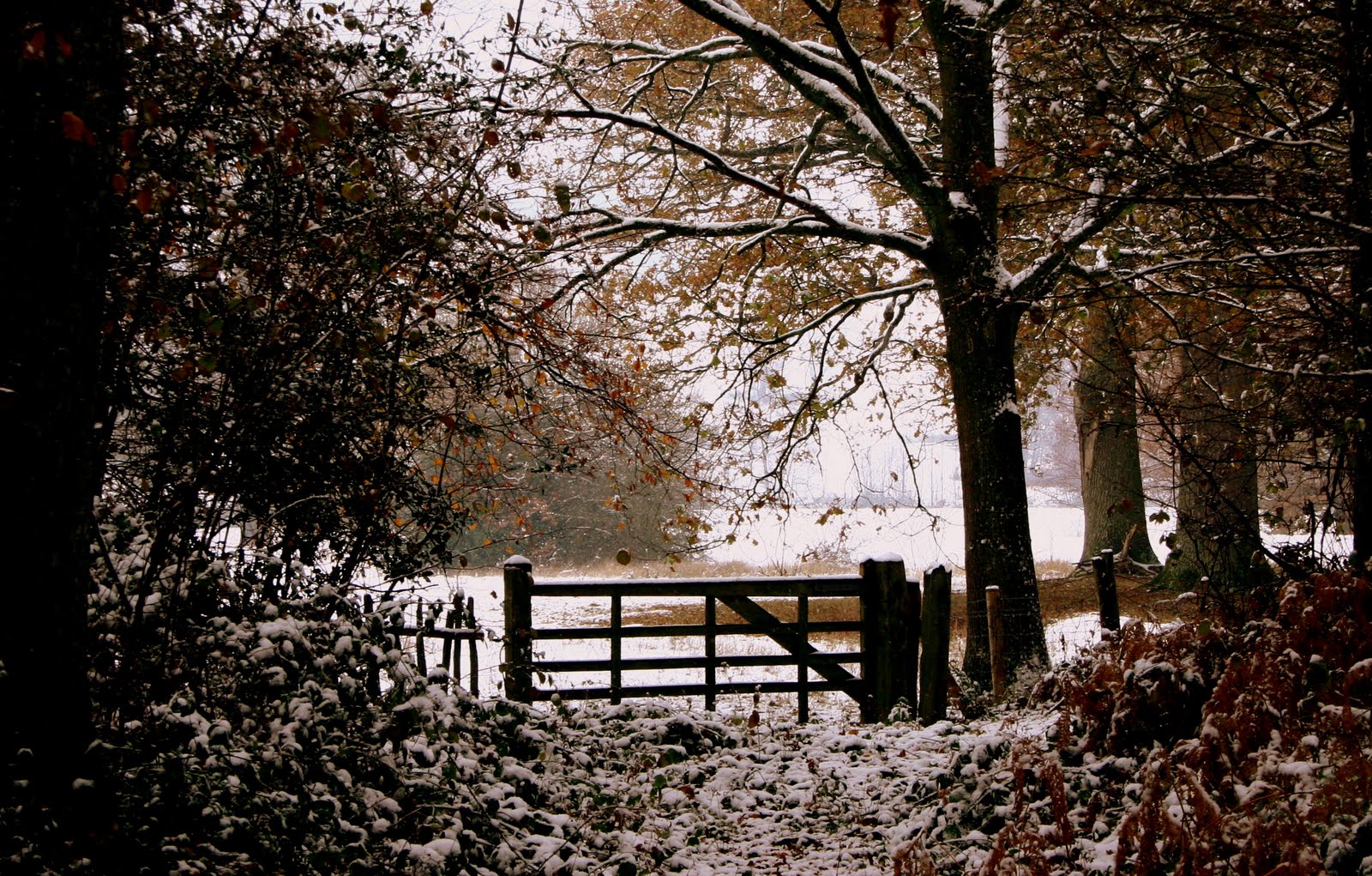
Only an inch or two by first light....

It seems too short a time since we last had a snowfall of such proportions. We moved house in the last lot only to be snowed in for a couple of days afterwards with up to sixteen inches more of the stuff. Not that we minded - it gave us a break to square the cottage. Yet here we are with November still not ended, temperatures dropping to stay at around freezing during the day and well below that during the night. Altnahara in the Highlands recorded -20 and -10 has been fairly common across the UK.

It does, however make for some pretty scenery and walking around the estate today with the camera proved lucrative enough as far as Chocolate Box photography is concerned.

My wife was saying how much she loves the sound of the crunch of footsteps in the snow and it really is an evocative sound. The sound and sight of snow takes one straight back to one's childhood. I wasn't brought up in the UK but West Germany until my teens and snow was certainly not uncommon over in Europe where my father was stationed, being further east. So snow for me is a direct memory link to my formative years, sledges, thick gloves and hats being requisite from November to February.

The Holly is full of berries this year...

Our bird feeders are taking a severe hammering. We're having to fill them up on a daily basis with a scattering of seeds around the base to feed the pheasants, robins, pied wagtails and other visitors that can't or don't like getting up to the feeders. I haven't seen much sign of the rabbits, though the squirrels are as abundant as always. I suppose all the wildlife struggles at this time of year, so we're glad to help really.


Thursday, 11 November 2010

Foraging Forays.

Mainly Parasol Mushrooms

Parasol Mushroom, Sweet Chestnut,
Field Mushroom, Hazel Nut,
Chantrelles, Rose Hips,
Ceps, Walnuts,
Boletus mushrooms, Rowan Berries,
Horse Mushrooms, Elderflowers,
Amathyst deceivers, Elderberries,
puffballs, Sloes,
Chicken of The Woods, Blackberries,
Wild Garlic. Sorrel,


The above list is most of what we've picked up in the woods over the last six months or so. Obviously care is needed when foraging - there are many pitfalls for the unwary, uneducated or merely hopeful. Certainly when picking mushrooms extreme caution should be excercised, there are a dozen or so mushrooms that can kill and several dozen that can cause severe gastric upsets. If you're not 100% sure - then don't eat it, don't even pick it!


Horse Mushroom
The same goes for some of the flora that can be foraged. There are many members of the potato and carrot family that can kill or at the very least cause severe illness, so again, make sure of what you're picking. There are many brilliant books available - try the River Cottage series on mushrooms, Hedgerow and Seashore for information, humour and recipes.

Sloes, chestnuts, hips and walnuts
 
But we've made chutneys, jams and jellies galore, sloe gin, bramble vodka, rosehip syrup, risottos, omlettes and eaten the nuts au naturelle, so to speak.

I would encourage anyone to get out with a couple of good books and have a good look around. It's fun, educational, healthy and free!

Monday, 1 November 2010

Bewl

Harry and I met again at this large Kent/East Sussex reservoir hoping for a change of luck and as I now live less than a mile away, it seemed churlish not to have yet another go at the pike that have eluded me thus far. Harry's had a couple including a lovely upper double - I usually catch trout!
This time we took deadbaits with us as well as lures - actually that should be well dead baits, as I'm sure they were not the freshest baits by a very large margin. However they worked, Harry, they worked.

The Autumn colours were as wonderful as always at this time of year and spotting the red maples amongst the yellow and gold birches, chestnut and beeches was a real joy, even more so as the day was bright, calm and mild. The reservoir, however, did not look as pretty being lower than I can ever remember seeing it before. With all the rain we've been having lately, one wonders where the water has gone.
Harry returns his fish
I was the first to catch after a couple of hours drifting and casting. We anchored up in a quiet spot, cast out a bait rod each and proceeded to cast a few lures around the boat keeping an eye on the floats as we did so. After almost an hour my float disappeared and the resulting 5 pound jack was as tatty as any I've caught before which leads me to wonder about the viability of Bewl as an ongoing fishery.
We then spent a few hours drifting and trolling and although we found many interesting features - we found no fish. I had one pull, from a trout probably, and as we settled back into the earlier, lucrative swim, Harry had a take on a small plastic which resulted in a small jack - but at least we both caught.
The shame of it was, as always, that just as things started to look up, we had to get back, the boat needed to be at the jetty by 4 pm. However, the fly anglers could stay out until dusk - another hour or so of fishing. I think our money is as good as theirs....


Saturday, 30 October 2010

Accidents will happen


Since we've lived in the cottage - we moved in January this year - we've had a plethora of accidents, incidents and happenings on the road alongside.
Although we live on the A21, we are shielded by trees which means the traffic is a quiet woosh and we don't hear the bangs and smashes that occur up and down the road. Usually, though, we see the cars pull up onto our drive, or the flash of indicators - sometimes even the police, ambulance or recovery truck.
So far we've had a young man who smashed his wheel and didn't know how to change it, a delivery van in a ditch, several lost drivers, a rear end shunting and, just last month, a deer hit. AS yet no-one has been hurt (except the deer) but we don't relish the next few shunts and scrapes.
The delivery van was an interesting case in point; he was delivering some items for my wife's business when he reversed into a ditch whilst turning. I towed him out with the Defender and he delivered his parcels. Then he drove into another ditch! Out with the Land Rover again.
The last incident with the deer was naturally a sad event as a wonderful large buck was killed. However, it wasn't wasted. The guys who hit it were on their way to a shoot and Steve, a colleague of their's, pulled up in his Nissan truck and three of us loaded the buck into the back. Later that evening he turned up with a shoulder of venison for me and two duck he'd shot that day. Very nice. I've since been on a couple of shoots and met some wonderful characters.