I had recently started my
trout fishing life in Kent, with a friend who patiently taught me how to cast
and had the inspired notion of ensuring that I caught a fish by teaching me in
a place where it was easy to do so – a fish farm. My first Rainbow weighed in
at around two pounds, fought like a locomotive and – because you paid for each fish
you caught – cost me about eight quid!
 |
| Fish Farm Trout |
But of course I was hooked too. There is something so
simplistic, so condensed about turning up at a water with a rod, a small bag and a net. No
bait, no seat, no rigs or weighty bombs to cast at the horizon – it seemed so
pure, so refined and so light! It was apparent that it would be easy to become
snobbish about the virtue of this inherent simplicity. And of course you could
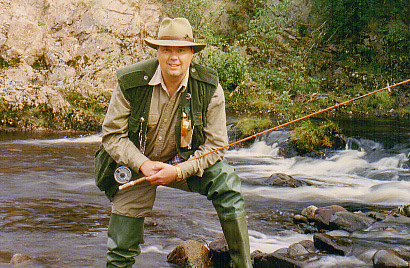
always leave the bag behind too because fly fishing is the only time in life that grown men could and should wear a waistcoat. I have seen some older gentlemen
sporting “gilets” while boarding aircraft or strolling along the promenade at Brighton –sometimes it’s almost a uniform in the checkout
at Heathrow - but it really shouldn’t be allowed. I blame the wives of these
safari gilet wearing warriors for permitting them to leave the house in such
attire – waistcoats are for, and only for,
fly fishermen.
 |
Waistcoated
|
I eventually left the fish
farm once my casting was sufficiently capable and approached the smaller,
stocked fly fisheries that could be located in the Trout Fishing magazines. At
these waters I learned the various ‘arts’ of fly fishing; drifting, intermediate
lines and fast sinking monstrosities that hooked up on everything that littered
the bottom of the lake; buzzers, nymphs, sparkly lures and the ubiquitous
Montana. I also caught a few ‘novelty’ fish like the golden rainbow and the
blue; some insipid looking brown trout which were anything but the expected “currants,
raisins and cloves” described by Henry Williamson, being rather silvery fish
with stubby tails looking poorly and limp, and I even caught tench on the fly in one Estate Lake in
Kent.
 |
| Golden Trout |
I went on to fish a local
reservoir; a vast water with depths of up to 70 or 80 feet but where the
majority of the trout are caught near the surface for most of the year, only
becoming unreachably elusive during the extreme heat or the severe cold. I
loved the splashy rise, the gentle sip or the “roll over” as the flies were
taken and, for a while became adept on the bank and in the boat – by adept I
mean that I occasionally caught a few of these ‘wilder’ fish and my casting
improved. I enjoyed the solitude of these larger waters, though of course, the
fish were still stocked; on the borders of Kent
and Sussex,
wild trout are, rarely, found in one or two locations only, so if one wishes to
catch a trout one must necessarily travel or put up with stockies.
I came to appreciate the art
of tying my own flies, always preferring to use natural materials, or at least
natural looking flies whenever
possible. Much of my writing about trout fishing traduces the “lure” – that
flashy imitation of nothing earthly - that angers a fish into snapping at your
“fly”, rather than taking one that it has been fooled into believing was a
nymph or midge lava or even a fry. Yet although I have used lures, especially
on the ‘dog’ days, when fish are reticent, deep or sleepy, I’m not very adept
at fishing them and feel less satisfaction catching with them – I am very
definitely a nymph man at heart.
But in 1990 I ‘discovered’ Scotland. I
arrived in Glencoe at 4 o’clock on a darkly glowering, crepuscular November afternoon and seemed
to feel the enormous weight of the mountains around me, their very mass barely
discernible in the heavy, wintry dusk, as the attenuated light leaked from the
landscape.
Scotland hooked me too. I
was captivated by its history, its forthright, sometimes dourly pragmatic
inhabitants, its cheerful national optimism and its gloriously diverse and
enchanting landscape. From that November accident (we started in Bath and just kept
driving… ) began a consanguineous affiliation that adhered to my Celtic descent
and forced a return, time and time again, sometimes two or three trips a year. It
would take me chapters to attempt to explain why I was so entranced by a
country that most people think too damp, dark or hard to reach, and in the end
it’s such a nebulous concept – a love affair with a country – that it would be
too difficult to define anyway.
Naturally, the love of
fishing and the love of Scotland
would coalesce, but it took a year or two for them to do so – I had separated
them in my mind as perhaps one would a mistress and a wife – never
conceptualising the union of the two. But of course it did happen – I was asked
by my partner at the time why I hadn’t taken fishing tackle with us on our
Scottish trips and I could give no valid, believable explanation, mumbling
something about ‘not fishing on holidays’ an obvious piece of fabrication as it
hadn’t stopped me Marlin Fishing in Gran Canaria or Bass fishing in Cornwall.
Thus the two loves – a country and a sport - were combined.
As far as Scottish fishing is
concerned, there are so many famous places and rivers. The sea at Malaig and
Oban, the lochs of Leven, Lomond, Ness and Ken, the rivers Tweed, Spey, Dee,
Tay and Don and a myriad of smaller rivers, burns, lochs and lochans – even one
lake. There are towns whose names are synonymous with the sport, Dunkeld,
Beauly, Kelso and Thurso and the entire country is veined with meandering
watercourses and potholed with glacial lochs of vastly differing sizes – it is
a veritable dream country for a fisherman.
It was in a marginally famous
river that I caught my first Scottish and truly wild, brown Trout – the
Blackwater.
It’s namesake in Ireland –
the Munster Blackwater - is probably more famous, starting in Kerry and flowing
out through Youghal harbour in County Cork with some magical salmon and trout
fishing beats in between. I have fished that river too, now. As we walked down
towards the falls of Rogie from the car park towards the Scottish Blackwater
near Contin, salmon were showing everywhere, splashing in pools as they fought
their way up-river in the inevitable battle against contour and elements to
spawn. I was persuaded by my girlfriend to fetch my gear from the car and have
a go, so I did, to some extremely disgruntled looks from the Salmon Angler
opposite. I tied a small red tag stick fly to a four pound point fishing as I
would in a fish farm stew pond back home – not knowing any better - and cast it
into the pool.
It felt like a momentous occasion that first
cast, almost ‘heavy’ yet I felt lightheaded; my hand tremulous, my breathing fast
and light. I didn’t want to catch a salmon – Heaven knows I wasn’t ready for
that yet – I just wanted to ‘fish’ and I wanted to hold a real, proper wild,
brown trout in my hand and just look.
It was perhaps three or four
casts later that I caught my first ever Scottish Brown Trout – a tiny, dark
peaty fish of maybe six inches or so. I was like a small child on his first
ever minnow fishing trip, amazed and filled with awe at the cascade of colours
on these predominantly green fish, but with so many swirls, whorls and blotches.
I counted several other colours and, surprisingly, not much actual brown. Only
six inches, but that first trout from Scotland could not have been more
welcome or more life changing for me. A few seconds after releasing the first fish,
I caught another, slightly smaller trout and then another.
 |
| The first 6 inch Brownie |
It was a wonderful moment in
time; the very slight pull on the line - sometimes like a breath of gossamer,
or as if a slight breeze had caught the material of the fly - would cause my
hand to twitch the rod a fraction of a second later, yet often that fraction,
that slight hesitation between sensation and brain impulse was eons too long in
trout time, the fish had already realised its mistake and spat out the coarse
imitation in disgust. Yet I had fooled it for an instant. I had duped the trout
into thinking that my size 16 twinkle midge was a real insect, a genuine item
of food. It didn’t matter that all the fish were small, what mattered was the
moment, the whole short episode of time, the period in which everything around
me tunnelled in on those few fish, that short, magic spell of catching ones
first truly wild trout.
By this time the surly salmon
angler had moved downstream and I was inexorably drawn back to the ‘real’ world
by a loud splashing and sudden movement on the opposite bank. I watched
entranced as he played and then lost a large tail-walking salmon. The fish was
there one second and gone the next, the line sagging towards the water like a broken
washing line as the water of the pool resumed its slow, washing-machine tumble.
I would have been completely distraught, raving and stamping around, throwing
my rod in the bushes and chewing through the nearest tree trunk, but he just stood
looking blankly at the water, still for a moment, then seemed to give an inward
shrug before retying his cast. No doubt his fate was different to mine; he has
probably caught many salmon each season and one lost fish is just another
episode in his ordinary, daily life.
I felt that it was time to
retreat. The tranquillity of the pool had been transformed into an angry,
brooding entity, the benignity had gone, the still quietude banished. The dark,
rocky shelf surrounding the pool was now a forbidding presence, a malevolent
gaoler rather than a welcoming gatekeeper.
 |
| Another wild Brown Trout |
As I climbed the hill back to
the car park it occurred to me that I had been blessed with some nice fish as a
gift, if you like, from the river, and this feeling has been prevalent from
time to time over the years. I have learned to react to the changing character
of rivers, lochs and lakes, when I am astute enough to feel these imperceptible
nuances of character shift and to accept the gifts when given with thanks.
Sounds daft? Well ok, I can accept that in the here and now, but I will still watch
for those mood changes and I will welcome them as gifts or warnings as
appropriate.
Scotland had presented me
with a gift and has pretty much kept on giving since. There have been many
wonderful trips, an amazing amount of magic moments to write about and to
commit to memory. I still go back to Scotland as often as I can – I just
can’t keep away.
 |
| Beautifully clean |